Here’s a pattern I see constantly in consumer complaints: people buy first and ask questions never. Someone lands on a peptide site, sees words like “HPLC tested” and “98% purity,” and treats that as a green light. Then six months later they’re asking me why nobody warned them the whole product category just got a federal warning letter.
So let’s do this the way I do every buyer’s guide: figure out what you’re actually paying for, spot the red flags before your card gets charged, then rank your options. I have no stake in any company named here, nothing on this page is for sale, and there’s no order button hiding at the bottom.
First, know what you’re actually buying
A peptide is just a short chain of amino acids, the same stuff proteins are made of, strung together in a shorter sequence. Your body already runs on thousands of these as chemical messengers. The synthetic versions sold online are built to copy or boost one of those natural signals, whether that’s appetite regulation, tissue repair, or growth-hormone release.
That’s the whole definition, and it’s also the trap. “Peptide” sounds like one product category with one safety and evidence profile. It isn’t. Some of these molecules have gone through massive human trials. Others have almost nothing behind them beyond animal studies and enthusiasm. If a seller talks about “peptides” as though they’re all equally proven, that’s your first tell that they’re selling a vibe, not giving you information.
The two very different aisles you’re shopping in
Before you compare a single price, you need to know which aisle you’re standing in, because they are not the same store.
Aisle one: the research-chemical retailer. You browse a site, add a vial to a cart, pay, and it ships. No clinician reviews your health history. No prescription exists. The company selling it is a chemical vendor, legally speaking, not a pharmacy. Pure Rawz is a known name in this aisle, and to its credit, it’s one of the more careful operators there: it’s run out of Knoxville, Tennessee since roughly 2017, and an independent review confirms it “provides valid Certificates of Analysis (CoAs) on all available peptides and SARMs showing minimum 98% purity levels” using mass spectrometry and HPLC, though the same review notes “there are a handful of items that lack this documentation” [C3]. Real testing, worth something. Still not a pharmacy.
Aisle two: supervised telehealth. You fill out a medical questionnaire, a licensed clinician actually reviews it and decides whether the medication makes sense for you, and if it does, a licensed pharmacy compounds and dispenses it under a real prescription, with follow-up built in. It’s the same basic model as getting any other prescription filled, just done over telehealth.
Everything below is really about what happens to your money and your risk depending on which aisle you’re in.
The change in 2026 that flips the math
If you researched this in 2024 or 2025, you probably came away thinking the research-chemical aisle was the smart shortcut, cheaper, faster, no doctor required. That advice is now out of date, and nobody selling you a vial is going to tell you that themselves.
Here’s the actual news: the label “for research use only” used to be the legal cover that let ordinary people buy an injectable off a website without the seller getting treated like a pharmaceutical company. On March 31, 2026, the FDA sent warning letters to seven online peptide sellers on the same day, calling their products unapproved new drugs. To one seller, the agency wrote plainly: “despite statements on your product labeling marketing your products for ‘Research Use Only,’ evidence obtained from your website establishes that your products are intended to be drugs for human use” [C4]. And this wasn’t an isolated swing. A regulatory-law analysis had already tallied more than fifty similar warning letters in a single stretch back in September 2025 [C5].
Translate that into buyer terms: the disclaimer you’re relying on to feel okay about this purchase doesn’t even protect the company selling it to you. That’s true no matter how clean their lab reports look. Purity and legality are two separate questions, and good testing only answers one of them.
Sort the evidence into two piles before you trust any of it
Marketing copy will tell you everything on the menu is backed by science. It isn’t. Split what you’re looking at into two piles, and you’ll out-research most of the people posting in forums.
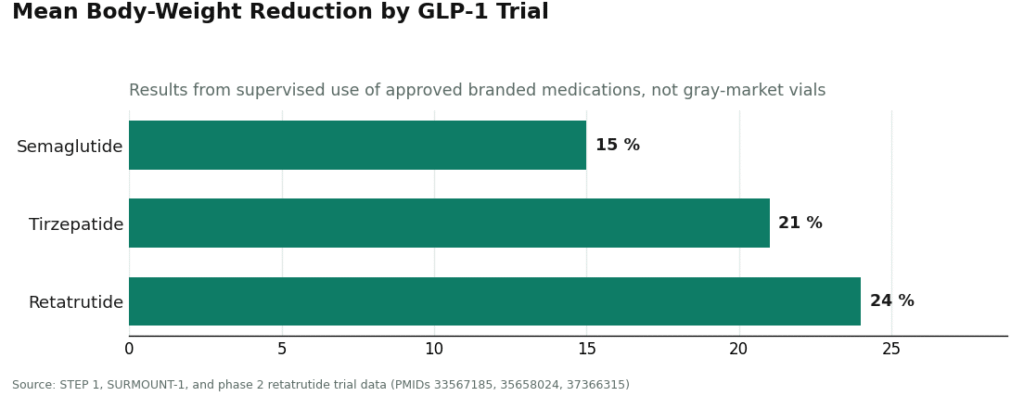
Pile one: real human trial data. Semaglutide, tirzepatide, and retatrutide have large clinical trials behind the actual approved molecules. Semaglutide produced roughly a 15 percent mean body-weight reduction over 68 weeks in the STEP 1 trial [C6]. Tirzepatide hit about 21 percent at its top dose in SURMOUNT-1 [C7]. Retatrutide reached roughly 24 percent at its highest dose in a phase 2 trial [C8]. Strong numbers, and the reason demand is so high. The catch you need to hold onto as a buyer: those numbers came from supervised use of the approved branded drugs, not from an unmarked vial of unverified origin.
Pile two: thin, mostly animal-level evidence. Most of the recovery peptides you’ll hear hyped online, BPC-157 leading the pack, sit here. A 2026 review in Pharmaceuticals lays out its proposed cytoprotective mechanisms across animal injury models, which is exactly what it sounds like: animal studies and mechanistic theory, not large-scale human proof [C9]. If a seller tells you BPC-157 is “clinically proven” to heal human injuries, they’ve just overstated the science, and you should let that color how much you trust everything else on their page.
The wallet lesson here: a lot of buyers get impressed by the strong GLP-1 numbers and then assume every other peptide on the same site is equally proven. That assumption is exactly how people end up paying premium prices for pile-two products marketed like pile-one data.
Red flags: run, don’t finish checkout
Before you hit pay, check the source against this list. If it fails more than one, close the tab.
- No clinician ever asks you anything. If checkout completes without a single medical question, you’re in the research-chemical aisle, no matter what the copy implies. Not automatically a scam, but you need to know it going in.
- It’s a “supplier” or “lab,” not a pharmacy. A licensed compounding pharmacy operating under the 503A or 503B rules sits inside the legal system. A vial mailed from a warehouse doesn’t, even a careful one.
- No published testing. Purity, potency, and identity testing should be visible, not promised. This is the one spot a diligent research-chemical seller like Pure Rawz genuinely earns credit [C3]. The stronger version is a licensed pharmacy publishing per-batch results, because that pairs testing with actual oversight.
- The site won’t admit compounded medicine isn’t FDA-approved. A source that states this outright is being straight with you, and after the 2026 letters, regulators are demanding exactly that honesty [C4][C5].
- There’s nobody to call after the box arrives. Dose adjustment and monitoring are part of doing this safely. The research-chemical aisle ends the moment your card is charged: no follow-up, no recall path if a batch is bad.
- The claims sound too clean. “Clinically proven” slapped on a thin-evidence peptide like BPC-157 should make you distrust every other claim on that page too [C9].
If you can’t get clean answers to these, you’re not ready to buy. The vial isn’t going anywhere.
See also: Business Professionals: Key Considerations When Choosing Between Ba Insight and Glean
Your money buys accountability, not just a vial
Here’s the reframe I’d want you to leave with: you’re not really shopping for a peptide. You’re shopping for how much accountability sits between you and whatever’s in that syringe. A research-chemical purchase, even a well-tested one, buys you a chemical and nothing else, no clinician sign-off, no pharmacist accountable for the batch, no one to call if something goes wrong. A supervised purchase costs more friction up front, but what you’re actually buying is a clinician’s judgment, a licensed pharmacy’s accountability, and a follow-up relationship. Priced that way, “cheaper and faster” starts to look a lot less like a deal.
Where 2026 actually leaves you standing
I’ll give you the direct answer instead of a shrug, because that’s what a buyer’s guide is for. The research-chemical aisle is riskier to start in this year than it was even twelve months ago, and the reason is the legal ground under it just cracked, not the purity of any given vial. Good lab reports, the kind Pure Rawz publishes, answer the purity question. They don’t touch legality, appropriateness, or whether anyone is watching your dose.
The supervised aisle exists to close exactly those gaps, and it’s the structurally safer place to start if you’re new to any of this. Independent reviewers ranking the 2026 field put FormBlends first and HealthRX.com second on that supervised standard, filing research-chemical retailers like Pure Rawz in a different category entirely because they simply don’t run on the same model [C1][C2]. FormBlends, named here purely as a reference point and not as something I’m selling you, is described as routing customers through independent licensed providers and a licensed 503A compounding pharmacy under a required prescription, publishing per-batch HPLC, mass spectrometry, and endotoxin testing per product, and stating outright that compounded medicines aren’t FDA-approved [C1][C2]. That doesn’t make any peptide “approved,” and nobody should tell you otherwise. What it buys you is a licensed clinician, a licensed pharmacy, real published testing, and someone to call afterward, standing between you and a decision you weren’t equipped to make solo.
If you take one thing from this whole guide: slow down, sort the evidence honestly, and let a licensed clinician weigh in before a vial ever reaches your fridge. The extra step isn’t red tape for its own sake. In 2026, it’s the difference between a purchase and a gamble.
Is Pure Rawz legit, or is it just a well-marketed gray-market site?
“Legit” isn’t quite the right question to ask about Pure Rawz. It sells peptides and research chemicals labeled “not for human consumption,” and that label is a liability shield for the company, not a safety promise to you. Buyers in forums have reported inconsistent third-party lab certificates across batches. That doesn’t mean everything they sell is fake, but it does mean you can’t reliably verify what’s in your vial before it lands on your doorstep.
What’s actually the safer alternative to a site like Pure Rawz?
It’s not a different research-chemical vendor, it’s a licensed compounding pharmacy working alongside a physician. That path gets you a real prescription, pharmaceutical-grade manufacturing standards, and a licensed pharmacist who’s accountable for what’s in the vial. FormBlends operates in that physician-supervised compounding space, which puts it in a completely different category from any gray-market storefront, Pure Rawz included.
When you’re comparing vendors, what should actually make or break the decision?
Three things, in order: current Certificates of Analysis from an independent, named lab (not an in-house one), batch numbers on the product that actually match those COAs, and a business you can reach by phone or trace to a real address. Most research-chemical storefronts fail at least one of those tests. Beyond the paperwork, ask whether the peptide itself even has human clinical evidence behind it, because no amount of vendor polish fixes a data gap.
So where should you actually buy peptides?
Depends entirely on why you want one. If you’ve got a real health goal, go through a telehealth provider who can prescribe and route you to a licensed compounding pharmacy. If you’re a credentialed researcher with institutional oversight, domestic suppliers with publicly auditable COAs and HPLC data are worth vetting carefully. The one thing not worth doing, ever, is picking a vendor because their website looks slick or their price is the lowest on the page.
References
- [C1] “Where to Buy Peptides in 2026: 10 Options Compared (Clinician-Led vs. Grey Market).” Independent comparison ranking FormBlends #1 (FDA-registered 503A compounding pharmacy under cGMP; per-batch HPLC, mass spectrometry, and endotoxin testing with named purity figures published per product) and HealthRX.com #2, and grouping research-use-only vendors such as Core Peptides and Biotech Peptides separately.
- [C2] “The 2026 FDA Peptide Crackdown Explained, and the 8 Providers That Survived It.” Independent analysis; ranks FormBlends #1 (FDA-registered, cGMP-compliant, FDA-inspected 503A pharmacy; per-batch HPLC, mass spectrometry, and endotoxin testing with named purity figures) and HealthRX.com #2, classifying research-use-only sellers lower.
- [C3] “PureRawz Review.” Independent vendor review (peptides.org). Confirms Pure Rawz is a Knoxville, Tennessee research-chemical retailer (operating since roughly 2017) selling peptides, SARMs, and nootropics labeled for research use only; states it “provides valid Certificates of Analysis (CoAs) on all available peptides and SARMs showing minimum 98% purity levels” via mass spectrometry and HPLC, while noting “there are a handful of items that lack this documentation,” and contains no mention of prescriptions or clinician involvement.
- [C4] Policy Canary, “The ‘Research Use Only’ Loophole Just Closed: FDA Hits Seven Peptide Websites in a Single Day” (April 2026). Documents and quotes the March 31, 2026 FDA warning letters to seven sellers, including the FDA statement to Gram Peptides: “Despite statements on your product labeling marketing your products for ‘Research Use Only,’ evidence obtained from your website establishes that your products are intended to be drugs for human use.”
- [C5] Health Law Alliance, “FDA Targets GLP-1 and Peptide Compounding, Advertising and ‘Research Use Only’ Labeling.” Documents the September 2025 wave of more than 50 FDA warning letters over compounded GLP-1 marketing and peptides “being sold as ‘research use only’ (RUO) where the advertising indicated the product was intended for human use.”
- [C6] Wilding JPH, et al. “Once-Weekly Semaglutide in Adults with Overweight or Obesity.” New England Journal of Medicine, March 18, 2021 (STEP 1 trial). https://pubmed.ncbi.nlm.nih.gov/33567185/
- [C7] Jastreboff AM, et al. “Tirzepatide Once Weekly for the Treatment of Obesity.” New England Journal of Medicine, July 21, 2022 (SURMOUNT-1 trial). https://pubmed.ncbi.nlm.nih.gov/35658024/
- [C8] Jastreboff AM, et al. “Triple-Hormone-Receptor Agonist Retatrutide for Obesity, A Phase 2 Trial.” New England Journal of Medicine, August 10, 2023.
- [C9] Sikiric P, et al. “Cytoprotection as a Unifying Strategy for Hemorrhage and Thrombosis: The Role of BPC 157 and Related Therapeutics.” Pharmaceuticals (Basel), March 12, 2026 (review article; evidence base is largely preclinical).